
The AI Operating Model Revolution
The AI Operating Model Revolution: 2026 Is Your Golden Chance to Move from AI Experimentation to AI Execution
Why Microsoft Power Platform AI Agents Are No Longer Optional—They're Your Competitive Edge
Your competitors aren't waiting. Neither should you.
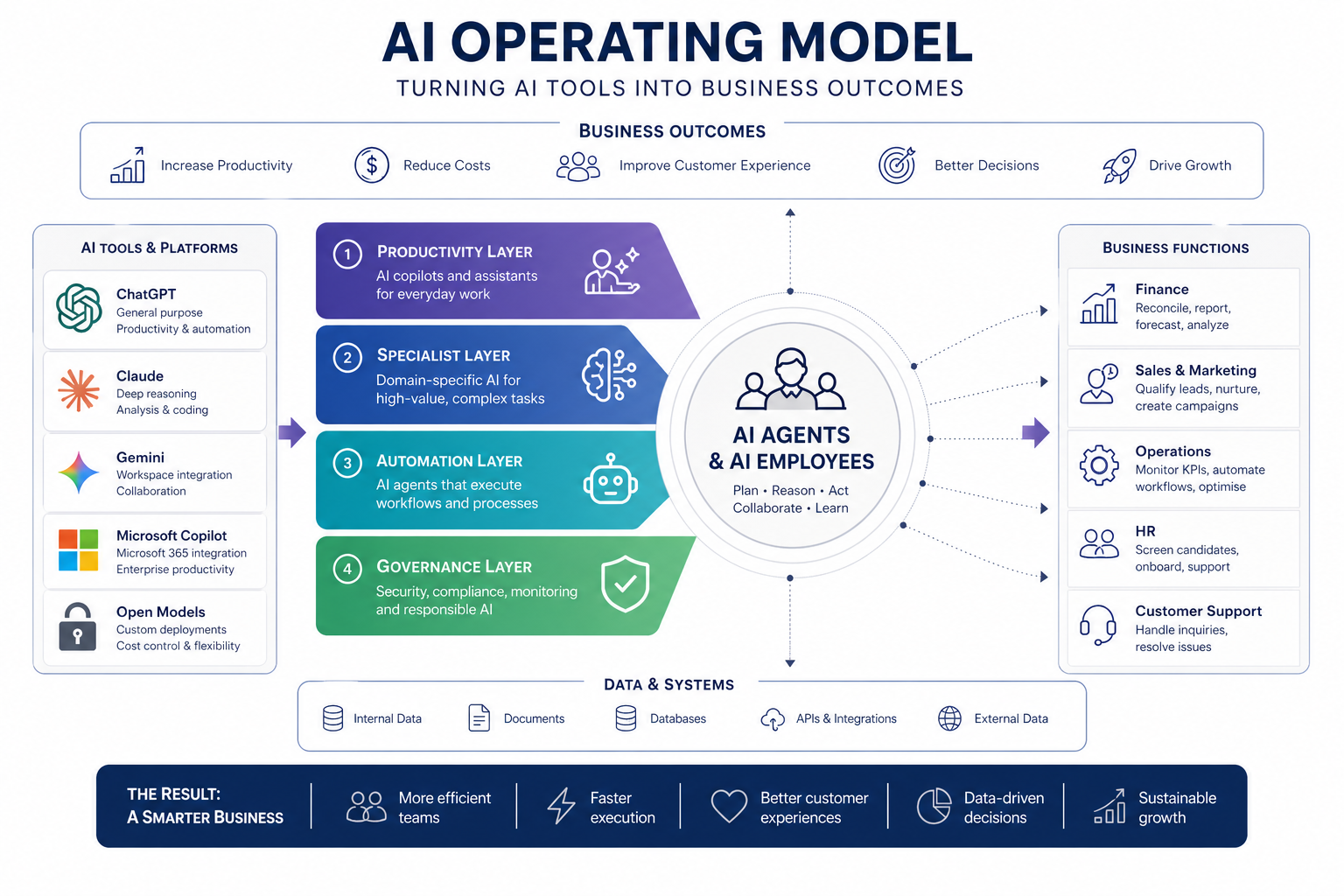
The Shift That Changes Everything
For the last two years, most organisations have treated AI as an assistant—a faster search engine, a writing tool, or a clever chatbot.
That era is ending.
What is emerging now is something far more transformational: AI as an operating model.
We are no longer just asking AI questions. We are assigning it outcomes. That shift changes everything.
If your organisation doesn't embed AI into the way your business actually runs in 2026, you will be strategically disadvantaged by 2027. And the gap will widen quickly.
From AI Tools to AI Employees
The biggest misunderstanding in the market today is viewing AI platforms as standalone tools. That mindset is already outdated.
The next phase is AI agents—systems capable of planning, reasoning, taking action, using software, accessing data, and completing multi-step tasks with minimal human intervention.
This is the difference between AI as software and AI as workforce capacity.
What This Actually Means
Old Model
- AI helps an employee write an email
- AI assists with report writing
- AI suggests answers to queries
- Human-dependent workflow
- Hours to complete tasks
New Model
- AI autonomously qualifies leads & books meetings
- AI gathers data, analyses trends, generates dashboards
- AI handles tier-one queries independently
- AI-driven workflow
- Minutes to complete tasks
For small and medium-sized businesses, IT leaders, CFOs, COOs, and CIOs, this is no longer theoretical. This is operational reality, happening now.
The AI Platform Landscape
We are entering a multi-model world, where different tools excel in different functions. The winning organisations will build an AI stack—a layered strategy combining specialist tools for maximum impact.
The most versatile all-rounder. Enterprise now represents 40% of OpenAI's revenue.
Where it Excels
- Business productivity
- General-purpose automation
- Sales automation & lead qualification
- Content generation
Enterprise Reality
Workspace Agents (May 2026) enable multi-agent systems. OpenAI's own sales team uses agents that research prospects, score them, and update CRM automatically.
Pricing
£16-20/user/month
The premium thinking engine. Enterprise demand accelerating rapidly. Revenue jumped £7.2B → £24B in 4 months.
Where it Excels
- Strategic analysis
- Code generation & technical automation
- Large-document review
- Compliance workflows
Enterprise Reality
Healthcare provider uses Claude agents to process patient intake, flag compliance issues, and route cases autonomously.
Pricing
£120-250/month
Enterprise Agent Platform designed for large-scale agent deployment, observability, and governance.
Where it Excels
- Workspace automation
- Internal collaboration
- Document workflows
- Multi-step processes
Enterprise Reality
Agent Studio for business users. Agent Development Kit for technical teams. 200+ model integrations.
Pricing
£150-300/month
Deep integration with Microsoft 365, Power Platform, and Azure. Enterprise controls built-in.
Where it Excels
- Enterprise productivity
- Compliance-led adoption
- Workflow automation
- Document intelligence
Enterprise Reality
Accounting firm uses Copilot agents to process expense reports in Outlook, categorise in Excel, route approvals through Teams.
Pricing
£80-160/month
Building Your AI Stack
The winning organisations don't choose one tool. They layer them:
Layer 1: Productivity
ChatGPT / Gemini / Copilot for daily work
Layer 2: Specialist
Claude for complex reasoning
Layer 3: Automation
Agents connected to business systems
Layer 4: Governance
Security, compliance, audit trails
The Rise of AI Agents and AI Employees
This is the real disruption. AI is moving beyond chat into autonomous execution.
What AI Agents Can Do
- Operate software and trigger automations
- Browse websites and gather information
- Interact with business systems and databases
- Collaborate across tools and platforms
- Complete multi-step tasks independently
- Learn and improve from feedback
Real-World Agent Examples
Finance Agent
Reconciles invoices, flags discrepancies, posts entries, generates variance reports—automatically.
HR Agent
Screens CVs, schedules interviews, sends rejections, onboards new hires—24/7.
Sales Agent
Nurtures leads, qualifies opportunities, books meetings, updates CRM—no manual work.
Support Agent
Handles tier-one queries, gathers info, routes complex issues, logs interactions.
This is not theoretical. The market is moving rapidly in this direction, with increasing adoption of autonomous and semi-autonomous agents across industries.
The Critical Moment: Your Window Is Closing
If Your Business Has No AI Strategy Yet, You Are Already Behind
AI adoption is no longer about innovation branding. It is about competitiveness.
Organisations that integrate AI into workflows today are compounding efficiency gains every month. Those delaying risk:
Higher Costs
Competitors automate, you hire
Slower Operations
Competitors move 10x faster
Talent Disadvantage
Young professionals expect AI at work
Strategic Vulnerability
Competitors capture market share
2026 should be the latest year your organisation defines its AI operating model.
Not "when budgets allow." This year—or at the very latest, next year.
The Competitive Reality
| Metric | Value | Impact |
|---|---|---|
| One junior employee cost | ~£28,000-40,000/year | 50-100x cheaper |
| One AI agent cost | ~£240-480/year | |
| Productivity boost (early adopters) | 50% increase | Compounding advantage |
| Leaders seeing workflow shifts | 9 in 10 (90%) | Industry-wide movement |
| Enterprise leaders planning agents | 81% in 2026 | Standard practice forming |
The question is not whether your competitors will deploy agents. The question is how quickly they will do it before you catch up.
What This Means for Your Business
If You're a SMB Owner
Your competitors aren't hiring armies of new staff. They're deploying AI agents for £16-40/month that work better than junior employees.
The Math:
- One junior employee: £28,000-40,000/year
- One AI agent: £240-480/year
- One AI agent: Works 24/7 without breaks
- Gap: 50-100x cheaper
You cannot compete on headcount. You can compete on automation.
Your Action: Identify your three most repetitive processes. Run a pilot on one within 90 days. Measure ROI. Scale what works.
If You're an IT Director
Your infrastructure is about to get complicated. AI agents interact with multiple systems, databases, and APIs. You need governance frameworks and security protocols before the business demands agents everywhere.
Your Critical Tasks:
- Map out which systems need agent access
- Define security and compliance requirements
- Plan your agent governance framework
- Identify integration points
- Build a technical roadmap
Timeline: Complete this audit by Q2 2026. You'll need 3-6 months to implement governance before agents go into production.
If You're a CIO
Your competitive advantage no longer comes from better software engineers. It comes from deploying AI agents faster than competitors. You're in a race for agent deployment capability.
Your Strategic Priorities:
- Choose your primary platform(s)
- Build or hire an agent development team
- Establish governance policies before you have 50+ agents
- Create a "centre of excellence" for agent development
- Measure and communicate ROI relentlessly
The Winning Playbook: Start with high-ROI, low-risk processes. Create feedback loops. Scale what works. Measure every outcome.
If You're a CFO
AI agents represent the fastest ROI in modern business technology. Payback period: weeks, not years.
| Function | Agent Cost | Employee Cost | Annual Saving | Break-even |
|---|---|---|---|---|
| Customer Service Agent | £384/year | £36,000/year | £35,616 | 4 days |
| Invoice Processing Agent | £192/year | £32,000/year | £31,808 | 2 days |
| Lead Qualification Agent | £480/year | £44,000/year | £43,520 | 4 days |
| Compliance Monitoring Agent | £240/year | £40,000/year | £39,760 | 2 days |
The math is unambiguous. A single AI agent pays for itself within days. Ten agents generate hundreds of thousands in annual savings.
Your Financial Strategy: Model agent deployment as capex with immediate cost recovery. Budget 15-20% of savings for development. Track cost per task before/after. Report to the board—they will be impressed.
If You're a COO
Your operational complexity is about to plummet. Processes that required 10 people can run on 2 people + 8 AI agents.
Your focus shifts from "How do we execute this process?" to "Which processes should AI agents run?"
Critical Actions:
- Audit your top 20 processes by volume and manual effort
- Identify which processes are suitable for agent automation
- Run pilots on your 3 highest-ROI processes
- Measure throughput, quality, cost before and after
- Roll out to all suitable processes by Q4 2026
Your 6-Month Action Plan
Here's exactly what to do, month by month:
Month 1: Discovery & Audit
Task: Audit your top 10-15 manual, repetitive processes
Owner: COO or IT Director
Time: 40 hours
Output: 3-5 processes ranked by ROI potential
Month 2: Pilot Selection & Business Case
Task: Choose one high-ROI process for pilot deployment
Examples: Invoice processing, lead qualification, customer triage, CV screening
Owner: CIO + process owner + CFO
Time: 20 hours
Output: Approved business case with board sign-off
Month 3: Platform Selection & POC
Task: Run parallel pilots on 2-3 platforms
Recommendation: ChatGPT (general), Claude (complex), your existing ecosystem
Owner: CIO + development team
Budget: £3,200-12,000
Time: 80-120 hours
Output: Clear winner platform selected based on data
Month 4-5: Production Deployment
Task: Deploy winning agent to production
Owner: IT Operations
Budget: £320-1,600/month ongoing
Time: 40-60 hours
Output: Agent running with documented ROI
Month 6+: Expansion & Governance
Task: Deploy to next 3-5 high-ROI processes
Actions: Hire agent engineers. Create governance framework. Scale your AI stack.
Owner: CIO, COO, IT Operations
Output: 5-10 agents in production. £50,000-200,000+/year documented savings
Final Thought: Is AI Becoming Part of the Org Chart?
Yes. Within three years, most organisations will have "AI employees" on operational dashboards just like human staff.
AI agents will have:
- Assigned outcomes and responsibilities
- Performance metrics and KPIs
- Cost allocation per process
- Upgrade cycles (new model versions)
- Governance and audit trails
They will be infrastructure, not novelty.
The question for your organisation is not "Should we do this?"
The real question is: How quickly can we move from experimentation to execution?
Get Your Customised Action Plan
Download our detailed 6-month roadmap with timelines, budgets, and KPI tracking templates—plus a risk assessment checklist.
Download PDF (Free)Calculate Your AI Agent ROI
Discover your potential return on investment. Adjust the values below to match your organisation's scenario.