Where Microsoft Copilot Fits in an Enterprise Automation Strategy
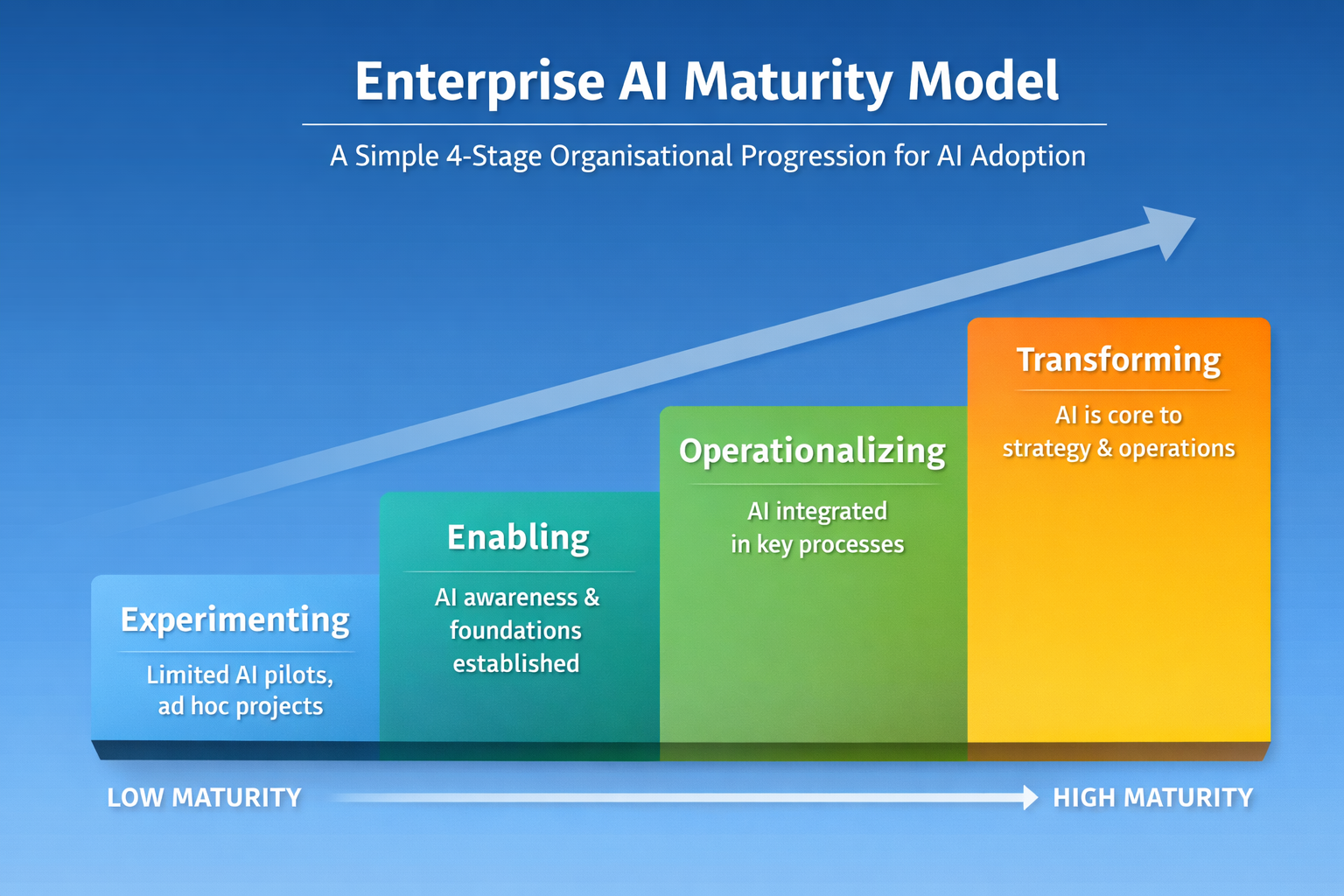
Enterprise automation is evolving at a pace few organisations anticipated. From traditional workflow automation to AI-driven decision augmentation, the rise of Microsoft Copilot presents a strategic opportunity—and a challenge—for CIOs, CTOs, Heads of IT, and Transformation Directors. Understanding where Copilot fits in your automation strategy is critical to capturing value while mitigating risk.
The Copilot Landscape
Microsoft’s Copilot ecosystem is diverse, encompassing several layers:
- Microsoft 365 Copilot – Embedded directly into apps like Word, Excel, PowerPoint, Teams, and Outlook. It enhances productivity by generating content, summarising information, and assisting with data insights.
- Copilot Studio – A tool for customising and extending Copilot experiences across the organisation, enabling domain-specific prompts, workflows, tooling and integrations.
- Embedded Copilots – AI agents integrated into line-of-business applications or portals, providing contextual assistance, recommendations, and automation directly within operational systems, for example externally facing support websites.
Understanding this landscape allows leaders to map Copilot capabilities against business needs, from knowledge work to operational decision-making.
AI vs Traditional Automation
Traditional automation—RPA, workflow tools, and rule-based systems—follows predefined instructions, delivering efficiency in predictable, repeatable tasks. AI, on the other hand, augments human decision-making: it analyses unstructured data, generates insights, and supports contextual actions.
Key distinctions:
- Predictable vs Adaptive: Traditional automation handles routine tasks; AI adapts to new data patterns.
- Rule-Based vs Insight-Driven: RPA executes logic; AI supports decisions with predictive intelligence.
- Cost vs Value: Traditional automation reduces operational cost; AI can unlock strategic advantage by enabling faster, smarter decisions.
Where AI Adds Value vs Risk
AI shines in areas that involve interpretation, summarisation, and decision support—but it introduces new risks:
Value:
- Content generation for reports and communications.
- Data summarisation and insights across multiple systems.
- Scenario modelling and predictive analytics to inform strategy.
Risk:
- Overreliance on AI outputs without human validation.
- Handling sensitive or regulated data.
- Bias in recommendations due to insufficiently diverse or curated datasets.
A clear governance framework is essential to ensure AI delivers value while keeping risk manageable.
From Workflow Automation to Decision Augmentation
The shift from automating workflows to augmenting decisions represents a fundamental change:
- Workflow automation reduces human effort on repetitive tasks.
- Decision augmentation empowers knowledge workers to make faster, more informed choices.
Copilot bridges this gap by combining embedded intelligence with workflow automation, creating a hybrid model where humans remain in the loop, but AI accelerates and improves decision quality.
Adopting a Copilot-Enabled Strategy
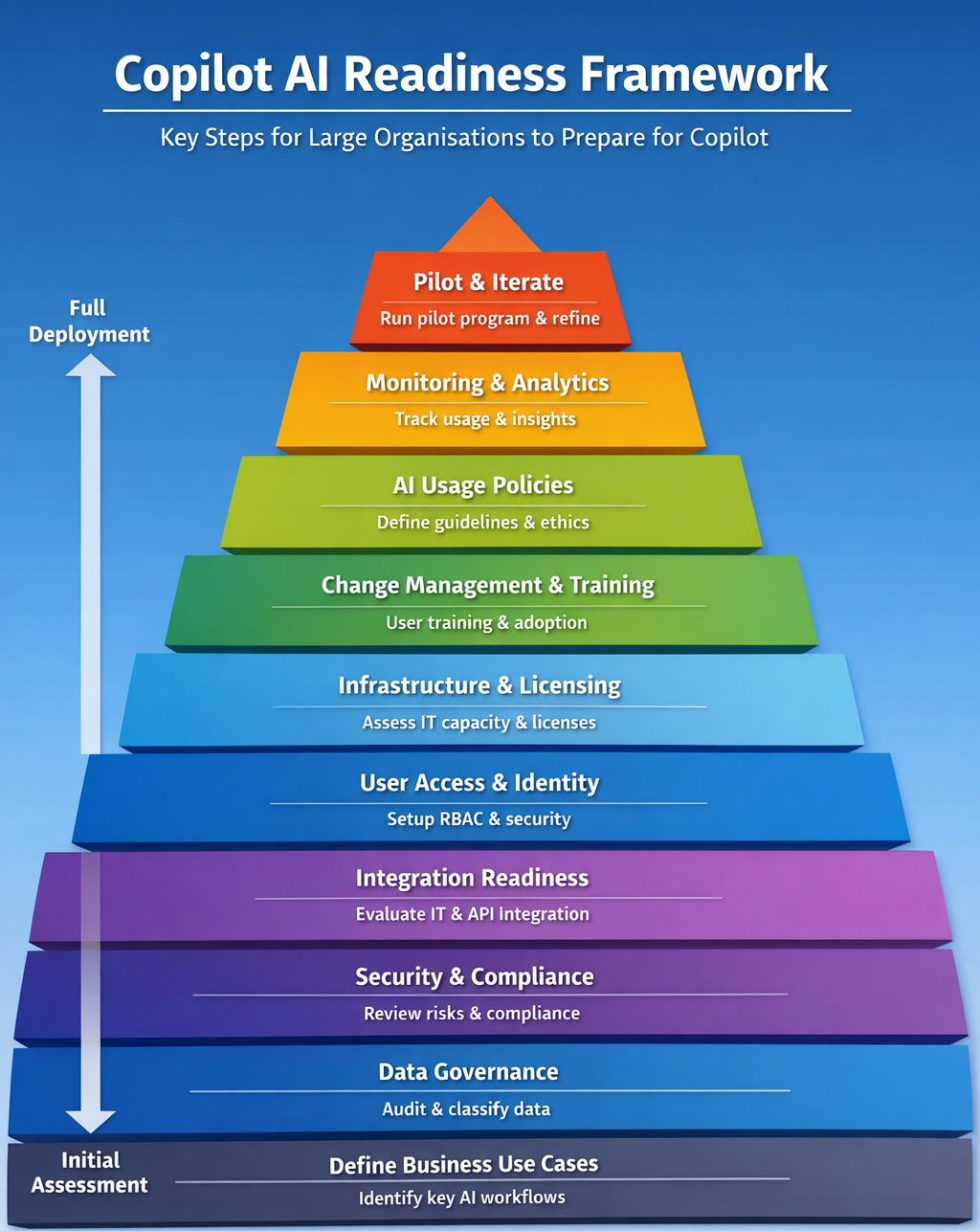
CIOs and senior leadership must integrate Copilot into the enterprise automation roadmap with a strategic lens. Key actions include:
- Map business objectives to Copilot capabilities – Identify processes that benefit from AI augmentation versus those suited for traditional automation.
- Develop governance and risk policies – Define data usage, human validation requirements, and ethical boundaries for AI.
- Establish training and adoption programs – Equip teams with the skills to leverage Copilot effectively.
- Pilot and measure impact – Start with high-value, low-risk processes to demonstrate ROI and refine best practices.
- Align with enterprise architecture – Ensure Copilot integrates seamlessly with existing IT systems, security frameworks, and cloud infrastructure.
Five Questions to Answer Before Starting Your Copilot Journey
- What processes are high-value candidates for AI augmentation?
- Do we have the right data quality, access, and governance to support AI?
- Which parts of the business will humans need to remain in the loop?
- How will we measure success and ROI for Copilot adoption?
- Which internal tools can help us assess readiness and adoption?
Tools that help access readiness and support deployment
Microsoft provides tools such as the Power Platform Center of Excellence (CoE) Starter Kit, Microsoft Viva Insights (replacing Productivity Score), Microsoft Purview Data Loss Prevention, Microsoft Entra Permissions Management, SharePoint admin and governance policies, Microsoft 365 security dashboards, and Microsoft Purview Data Security Posture Management (DSPM). These tools help organisations analyse current automation maturity, adoption, and readiness for AI-driven initiatives, enabling leaders to prioritise interventions and plan adoption strategically.
Conclusion
Microsoft Copilot is more than a productivity tool—it is a strategic enabler for enterprise automation and decision augmentation. For CIOs, CTOs, Heads of IT, and Transformation Directors, adopting Copilot thoughtfully means striking the right balance between opportunity and risk, governance and innovation, and human expertise and AI augmentation. Organisations that prioritise readiness, governance, and adoption from the outset can unlock the full potential of Copilot, driving smarter decisions and more efficient operations.
If you’re ready to explore how Copilot can fit into your enterprise automation strategy, our team can help assess your readiness, identify high-value use cases, and guide you through a secure, scalable AI adoption journey. Reach out today to start shaping the next generation of intelligent business workflows.
“By 2028, at least 15% of day-to-day work decisions will be made autonomously through agentic AI, up from 0% in 2024.*”
Quote from Gartner® 2025 Top Strategic Technology Trends E-Book